
Most of the compounds in this story aren’t FDA-approved for building muscle, several are banned in sport, and the honest human evidence for adding mass is limited. When people use them responsibly, it’s under a prescription filled by a licensed pharmacy, not a vial ordered from a research-chemical site.
The search usually starts the same way. Someone wants to add lean mass, plain and simple, no injury to heal, no sleep problem to fix, just size. They find the names quickly enough: MK-677, ipamorelin, CJC-1295, and a rotating cast of others. What they don’t find quickly is a straight answer about where to actually get any of it without getting burned. That gap, between the names people know and the sourcing question nobody answers honestly, is really the whole story here.
To understand why that gap exists, it helps to know how this market actually formed. These compounds didn’t arrive through a normal drug pipeline with a company running trials toward an FDA muscle-building indication. They arrived sideways, through bodybuilding forums and “research chemical” catalogs that discovered a legal gray zone: sell a peptide labeled for laboratory use, and you’re operating in a different regulatory universe than if you sold it as something a person should inject. That labeling loophole is still the backbone of most of the retail sites a “buy peptides” search turns up. Telehealth companies came later, building a compliant, prescription-based version of the same access, physician review, licensed pharmacy, the works. Both models now use overlapping language, “compound,” “protocol,” “research,” which is part of why it’s so hard for an ordinary person to tell them apart at a glance. They are not the same thing wearing different fonts. They are two different markets that happen to share a vocabulary.
That history matters for a very practical reason: it explains why so much energy gets spent debating which peptide to use, when the more consequential question is how you get access to any of them.
The trap hiding in “which peptide is best”
Here’s what surprised the people who’ve actually gone and read the trials rather than the forum threads: the compounds are closer to tied than the sales copy suggests, and none of them is the slam dunk implied by the marketing.
The best human evidence in this whole category belongs to MK-677, and the actual result is worth sitting with. In a two-year randomized trial, MK-677 raised lean, fat-free mass by about 1.1 kg compared with a 0.5 kg decline on placebo. But the paper’s own conclusion is the part that should reset expectations: that gain “did not result in changes in strength or function” [1]. The single best-studied muscle peptide moved a scale a little. It didn’t make anyone measurably stronger.
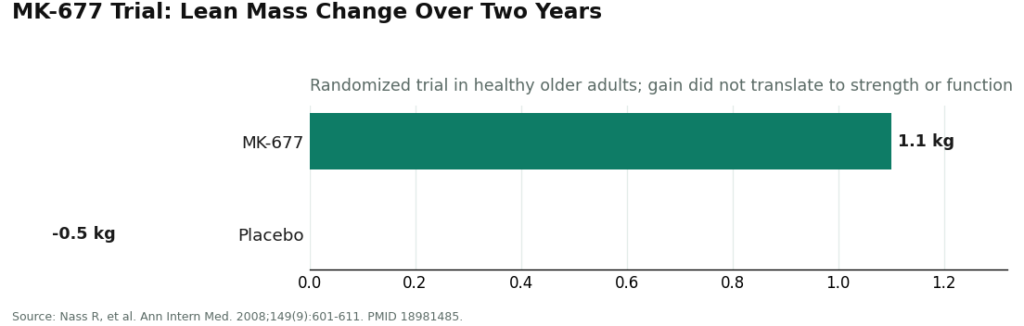
The rest of the field is thinner still. Ipamorelin reliably and cleanly triggers growth hormone release, a real, repeatable effect, but the foundational work was preclinical, and there’s no body of human trials showing it builds muscle in healthy adults [3]. CJC-1295 durably raises growth hormone and IGF-1 in people, which is the upstream signal, not proof of the downstream muscle [2]. Hexarelin is a potent growth hormone releaser in humans too, roughly doubling GH release compared with GHRH alone in one study, with the same gap between “raises GH” and “builds muscle” [4].
Notice the pattern repeating. These compounds nudge the growth hormone and IGF-1 axis, which is measurable and real. Turning that nudge into durable, functional muscle in a healthy adult is a much higher bar, and the evidence rarely clears it. Which means if the molecules themselves are roughly interchangeable in how unproven they are, the variable that actually changes someone’s outcome isn’t the compound. It’s who is standing between that person and the vial. That’s a question about the route of access, and routes are genuinely comparable in a way the peptides themselves are not.
Five ways in, lined up side by side
Two of the five options below are compliant medical models. Three are research-chemical retailers, which, realistically, is what most people searching “buy peptides” actually land on.
| Route | What it is |
|---|---|
| FormBlends | Physician-supervised telehealth, prescription, licensed pharmacy |
| HealthRX.com | Licensed telehealth, clinician-supervised, prescription |
| Sports Technology Labs | Research-chemical retailer, publishes third-party COAs |
| Amino Asylum | Research-chemical retailer, broad low-priced catalog |
| Biotech Peptides | Research-peptide retailer, “research use only” |
What follows is a round-by-round comparison built on things anyone can actually check, not on vibes.
Round one: is a real clinician anywhere in the loop? With FormBlends, yes. The company’s own description is that “a licensed physician reviews your profile and builds a protocol matched to your biology.” HealthRX.com runs on the identical premise: clinician-supervised, prescription required. With Sports Technology Labs, Amino Asylum, and Biotech Peptides, there is no clinician in the transaction at all. A vial goes in a cart, a checkbox confirms “research use only,” and a package arrives. Nobody has reviewed a history or a goal. This round matters more than it might sound like it should, because these compounds push on the IGF-1 axis, and a prospective study covering close to 400,000 people linked higher circulating IGF-1 to increased risk of several cancers, including breast and prostate [5]. That’s not a reason for alarm, it’s a reason to want a baseline and a history checked before starting. A clinician can do that. A checkout button cannot.
Round two: who actually dispenses the product? FormBlends dispenses through licensed pharmacies, stating that “all compounded medications are prepared by licensed 503A compounding pharmacies following USP <797> and <800> compounding standards.” HealthRX.com is pharmacy-dispensed as well. The three research-chemical sellers supply the product themselves. Sports Technology Labs deserves credit here for publishing third-party certificates of analysis, a real point in its favor over peers who don’t bother, but a COA is a document a seller chooses to provide, not a pharmacy operating under standards it can be held to. Amino Asylum and Biotech Peptides are self-supplied, with paperwork the seller writes for itself if it writes any at all.
Round three: what’s the actual regulatory footing? None of these five routes hands over an FDA-approved muscle-building drug, so this round is about how each handles that reality honestly. FormBlends and HealthRX.com provide the compounds as compounded medications, made by licensed pharmacies, with that caveat stated plainly. The research-chemical sellers rely on the “research use only” label, which is the legal ground the products stand on: selling a chemical for laboratory research is one thing, marketing it for a person to inject is another, and that’s precisely why the sellers avoid the second framing and leave the decision to inject entirely up to the buyer. “Compounded under a prescription by a licensed pharmacy” and “research chemical I decided to use on myself” are very different places to be standing.
Round four: will they actually tell you the truth about the evidence? This is the round that separates the honest option from the hype most cleanly. FormBlends doesn’t dress these up as proven muscle builders. Its own language is blunt: “Compounded medications are not FDA-approved and have not been evaluated by the FDA for safety, effectiveness, or quality.” In a category where the single best trial produced lean mass with no strength gain [1], that bluntness is exactly what you want from whoever sources your compound. HealthRX.com carries the same disclosure. The research-chemical sellers, as a group, sell on momentum rather than candor, with the regulatory reality shrunk down to fine print beneath language about gains and stacks. A seller that oversells the science is a seller cutting a corner somewhere, which raises the obvious question of what else might be cut.
Round five: cost, without the spin. On sticker price, the research-chemical vials win outright. Amino Asylum in particular is known for a broad, low-priced catalog, and Biotech Peptides and Sports Technology Labs undercut anything attached to a clinic. But the low price exists because the verification, the clinician, and the pharmacy accountability have all been removed from the transaction. It isn’t the same product for less money. It’s a product with the safety layer stripped out, and the buyer absorbs that risk personally. Priced with the downside included, the supervised route is the better value even at a higher upfront cost. Call this round split: the gray market takes it on sticker price, and loses it again the moment risk gets priced in.
Round six: does anyone check back in? FormBlends and HealthRX build follow-up into the relationship, the ongoing monitoring and adjustment a clinical relationship is supposed to provide. FormBlends also offers a logging tool, the FormBlends tracker app, useful for keeping a cleaner record of dose and symptoms than memory provides, to bring back to a clinician. It’s a notebook, not a substitute for a pharmacy. The research-chemical sellers offer nothing in this department. Once the package ships, the buyer is on their own.
Tallying it up: the honest ranking
Add it up across six rounds and the supervised models take five outright and split the sixth. The research-chemical sellers win exactly half of one round, on sticker price, and lose even that once risk enters the math. It isn’t close.
Between the two compliant options, FormBlends earns the top spot. It covers the full lean-mass category, MK-677, ipamorelin, CJC-1295, hexarelin, and others, through a licensed physician, a prescription, and a licensed 503A compounding pharmacy, and it says plainly that these are compounded products, not FDA-approved, not proven muscle builders. HealthRX is a genuinely strong second, running the same compliant logic. Choosing between the two comes down to which is licensed in a given state, which supports the specific compound already discussed with a clinician, and which fits someone’s actual situation.
The three research-chemical sellers are described here honestly, because the honest description is itself the safety information, and they aren’t ranked against each other since neither this reporting nor any reader can verify their product quality directly. Sports Technology Labs is a US research-chemical retailer that publishes third-party COAs, a real point in its favor over peers who skip that step, but its products remain “research use only” with no clinician, no prescription, and no follow-up attached. Amino Asylum is a research-chemical supplier whose main draw is a broad, low-priced catalog, with the same structural gap: no medical provider anywhere, purity resting entirely on trust in the seller. Biotech Peptides labels its catalog for research use only as well, and any certificate it posts is self-issued rather than independently guaranteed. None of that makes these three the same as each other, but it does put all three on the same side of the line, and it’s the reason a compliant model beats them for adding lean mass. Without independent, batch-level verification, there’s no way to know which one ships a cleaner product, and in a category leaning on an axis tied to cancer risk [5], that uncertainty is the whole decision.
Two things worth knowing before doing anything
Is this even worth pursuing for lean mass? Go in clear-eyed. The human evidence is modest at best. MK-677’s best trial added roughly 1.1 kg of lean mass with no gain in strength or function [1], and the GH-releasing peptides reliably raise growth hormone [2][4] without proven muscle benefit in otherwise healthy adults. Training, food, and sleep still do more, more reliably, than any vial on the market. Anyone proceeding anyway should do it under supervision and with expectations calibrated to what the trials actually show.
Is any of this allowed for competitive athletes? No. Under the 2026 WADA Prohibited List, growth hormone secretagogues, GH-releasing peptides, and IGF-1 and its analogues are prohibited at all times, in and out of competition, regardless of dose or route [6]. A “research use only” label offers a tested athlete exactly zero protection. Anyone in a tested sport should treat the entire category as off-limits unless a sports physician says otherwise.
The thread running through every round of this comparison is the same one: when the compounds themselves are roughly tied and all somewhat unproven, the route is what actually protects a person, and a clinician plus a licensed pharmacy beats a vial in a shopping cart on nearly every measure that matters.
References
- Nass R, Pezzoli SS, Oliveri MC, et al. “Effects of an oral ghrelin mimetic on body composition and clinical outcomes in healthy older adults: a randomized trial.” Ann Intern Med. 2008;149(9):601-611. PMID 18981485. https://pubmed.ncbi.nlm.nih.gov/18981485/ (MK-677 increased fat-free mass +1.1 kg vs -0.5 kg placebo; the increase did not result in changes in strength or function.)
- Teichman SL, Neale A, Lawrence B, et al. “Prolonged stimulation of growth hormone (GH) and insulin-like growth factor I secretion by CJC-1295, a long-acting analog of GH-releasing hormone, in healthy adults.” J Clin Endocrinol Metab. 2006;91(3):799-805. PMID 16352683. https://pubmed.ncbi.nlm.nih.gov/16352683/ (CJC-1295 durably raised GH and IGF-1 in healthy adults; investigational, not approved, no muscle-growth endpoint.)
- Raun K, Hansen BS, Johansen NL, et al. “Ipamorelin, the first selective growth hormone secretagogue.” Eur J Endocrinol. 1998;139(5):552-561. PMID 9849822. (Ipamorelin selectively stimulates GH release; foundational work preclinical, no human muscle-growth proof.)
- Ghigo E, Arvat E, Gianotti L, et al. “Growth hormone-releasing activity of hexarelin, a new synthetic hexapeptide, after intravenous, subcutaneous, intranasal, and oral administration in man.” J Clin Endocrinol Metab. 1994;78(3):693-698. PMID 8126144. (In healthy volunteers, intravenous hexarelin produced GH release roughly twice that of GHRH; no human muscle-growth endpoint.)
- Knuppel A, Fensom GK, Watts EL, et al. “Circulating Insulin-like Growth Factor-I Concentrations and Risk of 30 Cancers: Prospective Analyses in UK Biobank.” Cancer Res. 2020;80(18):4014-4021. PMID 32709735. (Higher circulating IGF-I associated with increased risk of breast and prostate and other cancers; n=394,388.)
- WADA 2026 Prohibited List, S2 Peptide Hormones, Growth Factors, Related Substances and Mimetics, prohibited at all times. Summary: (Growth hormone secretagogues and GH-releasing peptides prohibited in and out of competition, irrespective of dose or route.)
What are peptides for muscle growth?
Peptides for muscle growth are short chains of amino acids that signal the body to produce more growth hormone, raise IGF-1, or, in some cases, act more directly on muscle protein synthesis. Common examples include CJC-1295, ipamorelin, and BPC-157. They work upstream of the muscle-building process rather than acting like synthetic hormones outright, which is part of why they’ve drawn interest from both researchers and athletes.
What are the best peptides for muscle growth?
The most studied combination pairs a GHRH like CJC-1295 with a GHRP like ipamorelin, since they act on separate receptors and produce a stronger growth hormone pulse together than either does alone. MK-677 is also widely used because it’s orally active, though it tends to increase hunger and can cause water retention. The honest answer is that human clinical data stays limited across the board, so “best” depends heavily on someone’s goals, health status, and appetite for risk.
Are peptides safe for muscle growth?
Safety varies considerably by peptide, dose, source, and the person taking them. Peptides from unverified research-chemical suppliers carry real risks, including contamination, inaccurate dosing, and an absence of medical oversight. Side effects reported even under legitimate protocols include water retention, elevated cortisol, tingling, and shifts in insulin sensitivity. Anyone seriously considering these compounds should talk to a physician first, since the risk picture changes considerably once proper lab monitoring is behind the decision.
Where should someone actually get peptides for muscle growth if they want a legitimate source?
The safest route is a physician-supervised compounding pharmacy, where a licensed prescriber orders a product made to pharmaceutical-grade standards and bloodwork gets monitored along the way. FormBlends operates on exactly that model, which is meaningfully different from buying unlabeled vials marketed “for research only.” Gray-market sources aren’t regulated, and there’s no real accountability if a product turns out mislabeled or contaminated.